Three Months of Church Searching: A Retrospective
Intro
For the last few months I have gotten to do what American Christians call "church shopping/hopping" or more accurately named "church searching". This is the process of finding a new local church body, generally prompted by a need to leave the church one is currently attending. I've never done this search myself; every other church I've been a part of was determined by my parents or selected by default due to friends attending a specific church. In this post, I'm setting out to journal some of the lessons I learned and provide a blueprint for others and my future self if I ever have to do this again.
Why This Matters
Because leaving a church is usually messy, I try to switch churches as infrequently as possible. This means understanding what you're getting into with a new church becomes a big deal. Besides the obvious things like quality of worship and sermons, there are some things you might not realize you are committing to when you join a new church:
- Once you become a member, you will likely tithe to the church. It's important to know that your money is going to be used by the church faithfully.
- Church membership involves submitting to the authority of the elders. This could mean anything from the consequences of church leadership decisions to church discipline.
- Who you spend time and associate with has a meaningful influence on what you think and believe.
Choose your new church carefully.
Step 1: The Reasons
At this point, I'm assuming you have carefully considered the decision to stay or leave your current church and the reasons behind your choice. You did pray about it, right? If you conclude you cannot stay at your church any longer, it's time to make a list of reasons. People leave churches for all sorts of reasons ranging from innocuous things like driving distance to severe issues like sin or excommunication. Whatever the case, it's best to make a concrete list -- ideally written down. You'll be verbally sharing this list with numerous people, so it's best to memorize it and be able to articulate it well.
Public vs Private Reasons
I noticed as I had conversations with church congregants and elders that my elevator pitch for why I left my old church shifted over time to minimize the embarrassing reasons to focus on the more innocuous. I assume this applies to everyone due to human instinct to hide our insecurities from others. I propose a reasonable middle between the extremes of oversharing and lying, i.e., putting your best foot forward without being dishonest. This could look something like modifying, "The head elder Brian and I got in a heated argument after he dragged my favorite theologian during the sermon." to "The leadership team and I have theological differences that we couldn't reconcile, and in order to be faithful to my conscience, I have to look for another church." This is especially important if another's sin is the reason for leaving, where going into too much detail would constitute gossip. On the flip side, it's important to be transparent with your reasons, since new churches may have the same issues or have great solutions to these issues, and you'd never know unless you disclosed them during the church searching process.
Leaving Your Church Better than You Found It
The first action in finding a new church is leaving your old church. This step is often painful and people delay this initial step for far too long because it can feel like a betrayal to the leadership and other church members. Even worse, if the reasons for leaving are messy, performing the proper church exit, which is to talk through the decision to leave with the elders of your church, becomes one of those conversations you dread having. However, in most cases it's better to just rip the bandaid off once you've decided to leave. Finally, it's important to leave on the best note you possibly can. We should always seek unity with fellow believers, but more than this, your reputation will stay with your old church for years to come, so it is in your interest to preserve it.
Church Searching: Opportunity, not Burden
One of the most important lessons I learned in this process was to view church searching as an opportunity to do something different for a time. I came into this whole ordeal thinking the goal was to find a new church as quickly as possible. After all, we should not neglect in meeting together, right? Yes, but it's precisely because I believe consistent home church attendance is a good thing that I think you should take your time and really investigate things before jumping into a new church.
Depending on your personality, you might love or hate the church searching process. It involves having the same conversations over and over with different people, many of whom you will never see in this life again. For me, this process is exhausting and often leaves me feeling dissatisfied with surface-level conversations. On the flipside, church searching provides a chance to do the following things:
- Reconnect with friends who are scattered around various churches
- Learn about the state of churches in your city or town
- Learn about different denominations and their theological stances
- Learn about church governance/polity
- Gain a better understanding of your own theological stances by matching them up to other churches
Interestingly enough, this period of church searching has been more fruitful in terms of bible reading, theological study, and growing closer to God than many months of church attendance at a faithful church. It's forced me to take a closer look at what I believe and strengthened my identity of who I am in Christ.
Preferences vs Requirements
Even though I loathe the term "church shopping", it is useful in understanding that picking a church is at least in part a matter of checking the correct boxes. My approach to this is to list as many desirable characteristics you're looking for, then identify out of those which are absolutely necessary ("requirements"), then put everything else into the "preferences" bucket. Here's my personal requirements and preferences list:
- Requirements
- Biblically-based, God-glorifying, truth-seeking, and faithful
- Within reasonable driving distance
- Complimentarian stance
- Small groups and church community/social opportunities
- Not Catholic
- Preferences
- Tradition/denomination I am familiar with (Evangelical, Baptist)
- Familiar with the church or have friends who attend
- Expository sermon focus
- Age range demographic similar to my own
- Family-oriented and marriage-minded members and staff
- Focus on local community outreach and events
- Volunteer opportunities for actual good causes
Importantly, your list of requirements should be quite small. Even a limited set of requirements will meaningfully cut down on the possible churches you can attend. It's okay to have coffee and donuts on your preferences list. It's not okay to have as a requirement.
Finding, Researching, and Identifying Churches
In retrospect, not all churches will be listed on Google Maps or have a website, but I'd wager in 2026 that most churches, even the very smallest, have some sort of internet presence. Living in a medium-sized city, it would take years to visit every single church in my area, so we start with Google Maps. You can actually do "churches within 10 miles of me" and get good results.
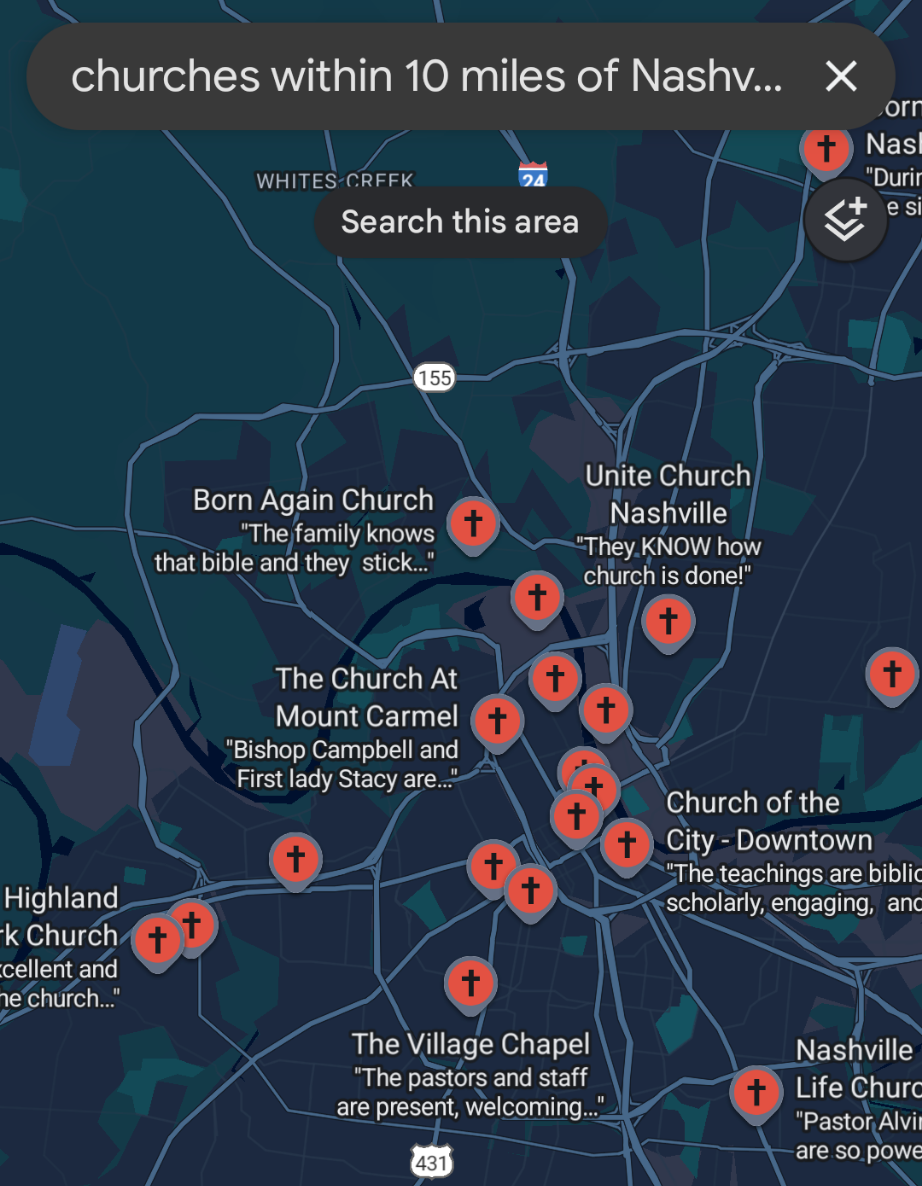
Each church should have a website listed with an elder affirmation of faith ("What We Believe") and "Staff" page that can give a good idea of the church's beliefs and views.
Many times, you can read blog posts or articles written by elders or watch recorded sermons online to get an idea of what the leadership believes and how they approach running their church.
In parallel to this impersonal, Internet-based method, talk to friends and acquaintances, especially those you don't know well, asking them what church they currently go to and their opinions on other churches in the area. One of the upsides of talking to people is the greater understanding on certain views, controversies, or issues within a church that will typically not be published on their website.
Eventually, you should have a list of churches you'd like to visit. Keep a list on your phone of each church visited or planning to visit with associated items like driving distance, particular views, membership numbers, and other information that might be relevant to your requirements and preferences.
Putting in the Hours hours hours
Visiting churches is the most time-consuming part of the process, but as discussed before, never a waste of time -- even if you visit a church you're definitely sure you won't come back to. I suggest visiting one different church per week. I'm not a fan of trying to visit multiple Sunday services in the same day, and think a new church is best experienced on the day you would actually attend, typically Sunday mornings.
Church is not passive, and even when visiting a new church, I try to participate as if I was a member: sing, take communion (if allowed), and interact with fellow believers. I will take some notes during the sermon that I can reflect on later.
I'm finding the most important part of visiting a church is talking to people after the service. It's here where you can get a lot of good information from people about the church itself. I try to avoid spending too much time on topics I could look up on the website, such as small groups, campus locations, etc. The best people to talk to, if available, are the pastors. They can give you the best and authoritative information on the story of the church, views, and sometimes even important information that would never be listed on their website, such as church health and political undercurrents.
Avoiding Choice Paralysis
If you did the previous step correctly, you should have a list of a handful of churches that stood out. It can be based on specific items from your lists, but also "vibes", which includes the unquantifiables like how friendly that lady you talked to after the church service was. You might even feel like there are multiple churches you wish you could attend.
My next step is to try to schedule a coffee or lunch meeting with one of the pastors. Regardless of how the meeting goes, a pastor willing to set up a time to meet with you is an immediate green flag, and failing to schedule something is a red one. This isn't about job interviewing where you're trying to find the best church possible, but instead to learn more about the church to become better integrated into the local body if you do decide to join. Is the pastor involved with the congregation on other days than Sunday? I also found that these meetings were some of the best in terms of spiritual growth: figuring out life goals, solidifying or modifying my beliefs, and re-encouraging me to keep doing the things I needed to do.
At this point, it's all review. Talk about your reasons for leaving your old church, the requirements and preferences for a new church, and ask the pastor if the church would be a good fit for you. Ask them if there are any church issues you should know about. Counter-intuitively, certain issues may also be a good reason to join a church. Say, for example, a church is not doing well with their finances and needs a finance director and you happen to have experience in the finance industry. This could actually be a great fit, even moreso than a church with their finances put together.
Finally
After enough meetings with pastors and introducing yourself so many times it feels like you never want to introduce yourself again, you should have it narrowed down to 2 or 3 churches. Finally, how do we know which church to choose? Answer: You pray. Ask God for wisdom in general and also specifically to help you know which church to choose.
Johnny Mac C has this great quote about discerning God's will:
The will of God is not, first of all, for you to go there or work here. The will of God concerns you as a person. If you are the right you, you can follow your desires and you will fulfill His will.
In summary, as long as you are living in submission to God, any of these churches will be the right church. They are all right answers. In other words, whichever church you end up picking will be God's will for you to attend.